
Hydrogen as an alternative Daimler Truck's GenH2 test year and 2026 production plan
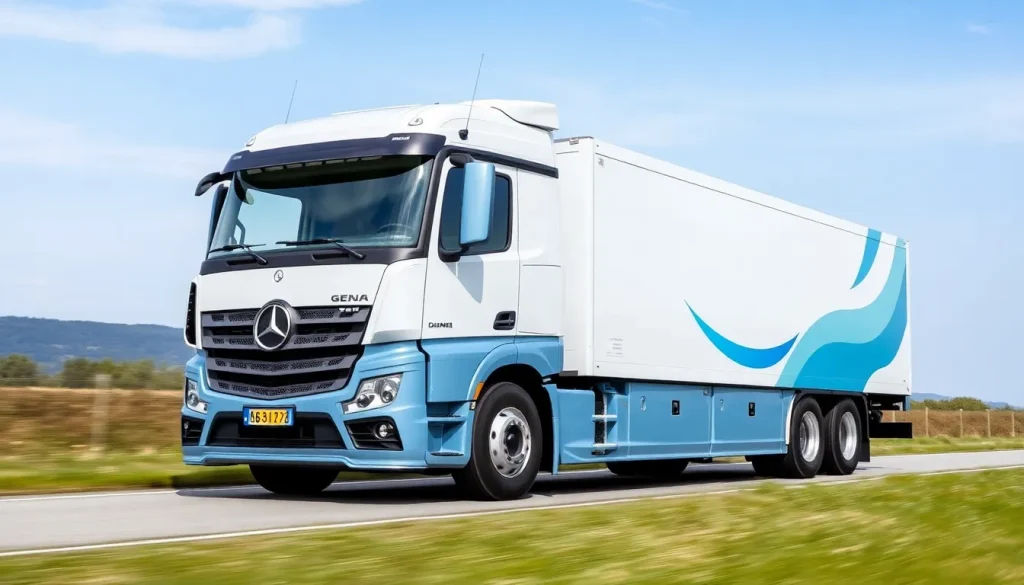
Daimler Truck has successfully completed the first year of real-world testing for its hydrogen-powered truck, the Mercedes-Benz GenH2. This model is positioned as a cornerstone of the company’s strategy for emission-free heavy transport. Since July 2024, five units of this prototype have been integrated into fleets of companies such as Amazon, Air Products, Holcim, INEOS Inovyn, and Wiedmann & Winz, collectively covering over 225,000 kilometers—equivalent to five and a half laps around the globe.
The Environmental Impact of Hydrogen Trucks
The environmental implications of these trials are significant. If the same distance had been traversed by a typical 25.6-ton diesel truck, it would have consumed approximately 58,000 liters of diesel and emitted around 154 tons of CO2. In contrast, the GenH2 demonstrated hydrogen consumption rates between 5.6 and 8 kg per 100 km, depending on the application, for vehicles weighing between 16 and 34 tons.
- Traditional Diesel Consumption: 58,000 liters for 225,000 km.
- CO2 Emissions: 154 tons from diesel trucks.
- Hydrogen Consumption: Between 5.6 and 8 kg per 100 km.
Fuel Cell Technology Developments
The fuel cell technology utilized in the GenH2 is developed by cellcentric, a joint venture between Daimler Truck and the Volvo Group. This enables the trucks to achieve ranges exceeding 1,000 kilometers and allows for refueling in just 10 to 15 minutes, providing performance that rivals traditional diesel engines. Additionally, drivers have appreciated the smooth handling, low noise levels, and the engine's responsive performance.
Applications and Operational Experiences
Each partner company utilized the GenH2 in specific operational contexts:
- Amazon: Integrated into logistics routes across Germany.
- Air Products: Used for transporting various gases.
- Holcim: Employed for cement distribution in Germany and the Netherlands.
- Wiedmann & Winz: Focused on container transport.
- INEOS Inovyn: Applied for the transportation of chemical products.
Hydrogen Refueling Infrastructure
Throughout the year, the five GenH2 trucks completed 285 refuels at liquid hydrogen stations in Wörth am Rhein and Duisburg, loading a total of 15 tons of fuel. The use of liquid hydrogen in 40 kg tanks showed clear advantages over gaseous hydrogen, particularly in terms of energy density and the balance between range and weight.
Challenges Facing Hydrogen Adoption
Despite the promising results, Daimler Truck has acknowledged several challenges that lie ahead. The limited availability of a comprehensive network of liquid hydrogen stations and the high costs associated with fuel and insurance are barriers that hinder competitiveness against diesel alternatives. For a widespread deployment of hydrogen technology, Europe will need to establish at least 2,000 refueling points by 2030.
Future Testing and Production Plans
The second phase of testing is set to begin in the last quarter of 2025 with an additional five customers. Daimler Truck plans to initiate series production of the GenH2 in 2026 at its Wörth facility, focusing initially on the European market. In the medium term, the company envisions a dual strategy that combines battery-electric and hydrogen fuel cell trucks, although mass adoption of hydrogen technology is not expected to occur until the next decade.
Conclusion: A Look Ahead at Hydrogen in Transportation
The progress made by Daimler Truck with the GenH2 marks a significant step toward sustainable transportation solutions. As the company navigates the challenges of infrastructure and costs, the successful implementation of hydrogen technology could redefine heavy-duty transport, offering a cleaner alternative that aligns with global emissions reduction goals. The journey toward a hydrogen-based transport future is just beginning, and its potential is vast.
 Mercedes-Benz eActros 600 LS trucks for TransBernal
 Volkswagen Meteor: Celebrating Five Years in the Heavy Truck Market
 ACARA Report: 2,085 Heavy Vehicles Registered in August, Top Seller Mercedes-Benz Atego 1932
 Volkswagen Trucks and Buses at the International Mining Convention
If you want to know other articles similar to Hydrogen as an alternative Daimler Truck's GenH2 test year and 2026 production plan you can visit the category Uncategorized.
Leave a Reply
RELATED POSTS